Pleiades
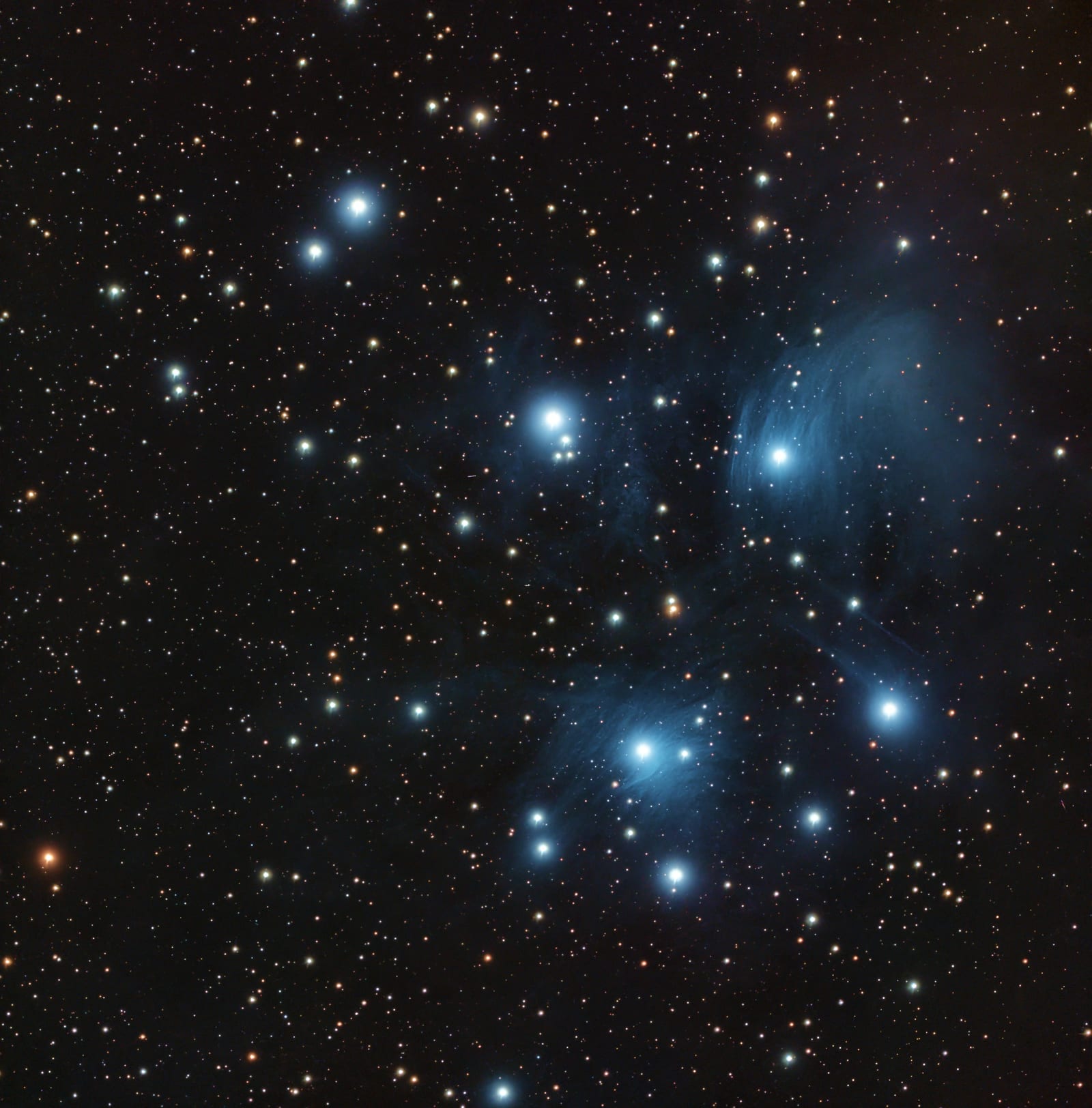
The Pleiades shine with delicate blue reflection nebulae in the rising autumn sky.
M45, the Pleiades open cluster in Taurus, is one of the most striking binocular objects; fine dust around the hot stars scatters their light into bluish nebulae.
The current image from 26 September 2026 combines 1,043 exposures of 10 seconds, for a total of 2 h 53 min 50 s.
The 250 mm field at f/5 frames the cluster generously and lets the dust streamers fade softly into the background.
Catalogue: M 45
Capture date: 2026-09-26
Total exposure: 10430 s
Imaging and processing: Ulrich Schwarz · Vespera Pro
Welcome to the Pleiades in Taurus. In this image from September twenty-sixth, twenty twenty-six, we encounter bright stars and broad blue veils of nebulosity. First we take in the whole cluster. Then we visit Atlas and Pleione, the fans of dust near Merope and Maia, and finally Alcyone. Let your eyes wander between the stars as well: this is where the faint light of the dust clouds becomes visible.
Begin with the pattern of the whole cluster. Just a few bright stars make the Pleiades unmistakable, but the group contains many more members than this image highlights individually. The stars and the passing dust cloud tell different stories: the visible reflection nebula is not simply leftover material from the cluster’s birth.
Atlas and Pleione form a striking pair in this image. Begin with the brighter Atlas. Then find the smaller point of light close beside it: that is our next stop, Pleione. These two stars provide a useful starting point for finding our way through the cluster. Their separation in the image is an angle on the sky; a photograph alone does not reveal the physical distance between two stars.
Now we pause at Pleione. Compare its smaller glow with that of Atlas. The size of a stellar spot in this image is not the star’s actual diameter: optics, exposure and processing shape its appearance. Here the stars remain point-like sources of light. From this close pair, our gaze will move to much more extended structures: the blue veils around Merope.
At Merope, look at the interplay between a bright star and faint nebulosity. Surrounding dust scatters starlight towards us. Fine veils require sufficient image contrast to become visible. The large glow immediately around the star also includes effects from optics, exposure and image processing.
Maia provides another landmark in the stellar pattern. Compare its surroundings with those of Merope. The blue veils are not spread evenly across the cluster. We see a three-dimensional dust cloud as a flat image. This single observation cannot reveal its true depth.
Alcyone helps us return from the details to the whole cluster. Compare the spacing of the bright stars, then notice the much fainter points in the background. Not every star along this line of sight belongs to the Pleiades. Additional measurements reveal which stars really move together through space.