NGC 891 – Silbersplitter-Galaxie
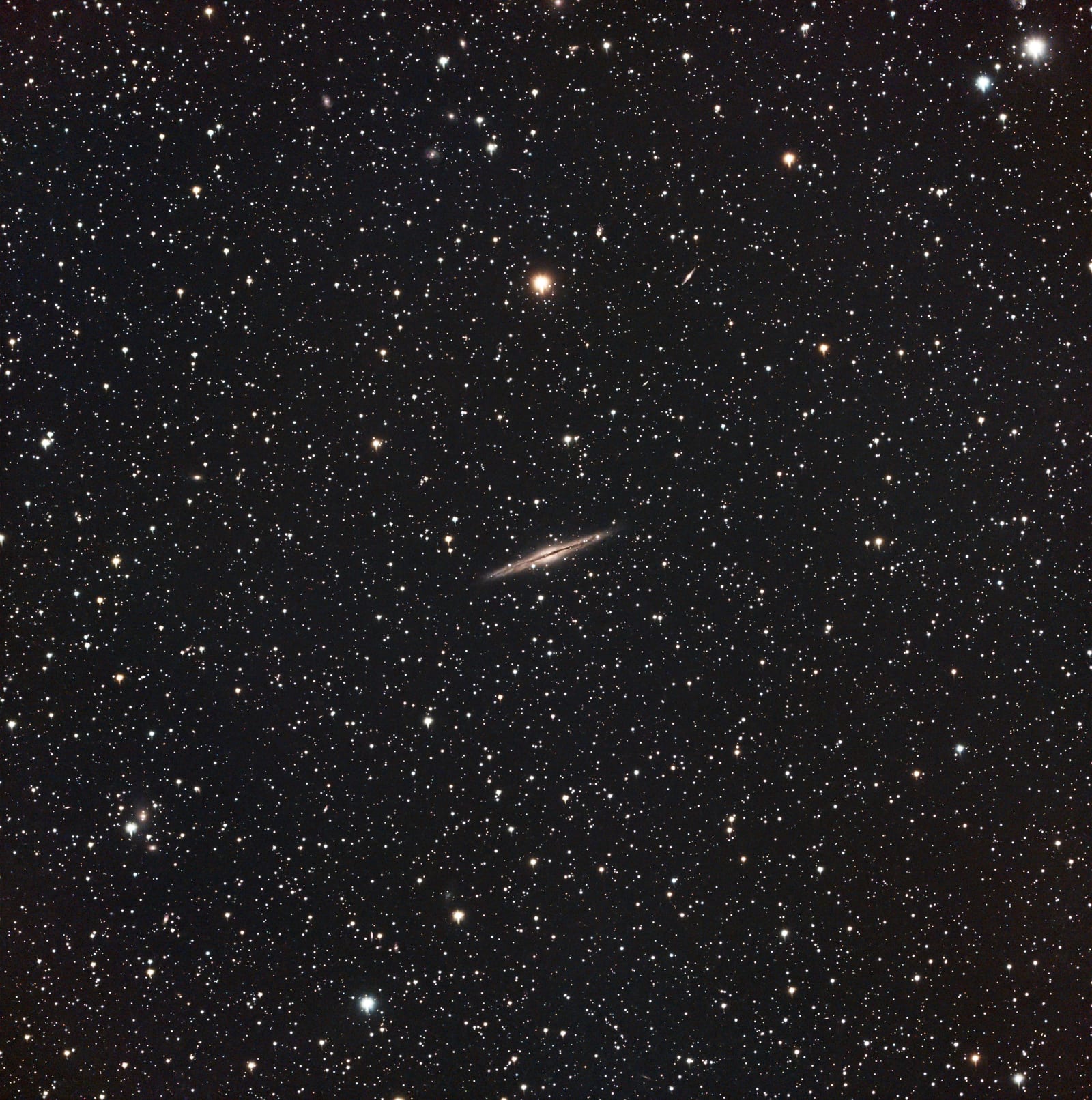
More integration on NGC 891 brings the dark central band into clearer relief.
This edge-on galaxy captivates with its continuous dust lane and delicate outer halos—an impressive profile view.
The longer total exposure teases out the lane and diffuse halo more clearly, despite 21° altitude and humid air.
A wide-field optic at f/5 keeps the entire slender disk in a balanced frame.
Catalogue: NGC 891 · UGC 1831 · MCG 7-05-046 · CGCG 538-52 · PGC 9031
Capture date: 2026-09-25
Total exposure: 14670 s
Imaging and processing: Ulrich Schwarz · Vespera Pro
Welcome to NGC 891 in the constellation Andromeda. About thirty million light-years away, we see a large spiral galaxy almost exactly edge-on. This perspective reveals structures that would blend together in a face-on view. Our journey follows the bright centre, the dark dust lane and the long stellar disk before rising into the faint halo above its plane.
NGC 891 is a large spiral galaxy whose disk we see almost exactly edge-on. In this image it therefore resembles a narrow needle of light rather than a spiral. Spanning roughly one hundred thousand light-years, it is comparable in scale to our Milky Way. This side-on view makes NGC 891 an especially revealing laboratory for studying a galaxy's disk, dust and halo.
A dark band runs through the luminous disk. It is not an empty gap, but cold interstellar dust and gas that absorb and scatter part of the starlight behind them. Because our view passes along the edge of the disk, many individual dust clouds overlap to form an almost continuous silhouette. Bright and dark regions therefore reveal the galaxy's layered structure together.
We follow the disk towards the northeast. Its light grows fainter outwards, while the dust lane remains visible as a fine division. In a spiral galaxy, star-forming regions, gas clouds and spiral arms overlap here along the same line of sight. The edge-on perspective therefore hides the familiar spiral pattern but emphasises the impression of a very thin, extended stellar disk.
At the southwestern end, the disk is not perfectly symmetrical. Real galaxies are not rigid geometric figures: dust distribution, star formation and the spatial arrangement of spiral arms change their brightness from place to place. This image records the whole system in nearly four hours of collected light, while every image element combines contributions from countless stars.
For our final stop, the view rises above the disk plane. High-resolution observations reveal filaments of dust and gas extending hundreds to thousands of light-years into the halo. Star formation and supernovae can drive material out of the disk, while far-infrared measurements also reveal extended cold dust. In this amateur image the halo appears only as a very faint glow; its physical structure emerges only by comparing many wavelengths.